Menu
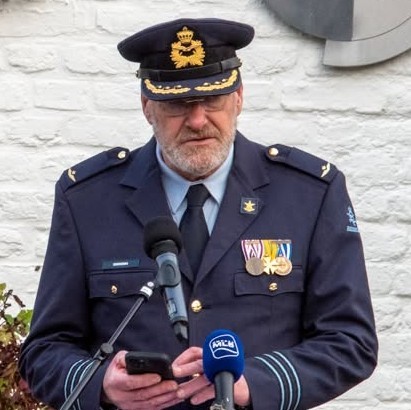
Speech by Humanist Chaplain Drs. Sietse Sinnema
Dear friends, We are standing here in a special place: the Monument of Tolerance in the heart of the Leudal. Every year, we gather here around November 16, the day this region was liberated in 1944. We look at this bronze sculpture and see the triangle, the half-arch, the seagulls symbolizing freedom, and we see two clasped hands above the sword and the laurel wreath. Beneath them lie the Meuse river cobbles. More than 800 stones, one for every soldier who gave their life here, far from home. Coming from 11 different countries. Allies and Germans, united in death, remembered in tolerance.
Today, I want to reflect on the name of this monument. Monument of Tolerance. Het Monument van Verdraagzaamheid. And more specifically, I want to talk about two words we often mention in the same breath, yet which in reality make a world of difference: tolerating and accepting.
Because let’s be honest: we live in a time when those words are under pressure. We hear them in the news, on the street, and at the kitchen table. But do we still know what they truly mean?
Tolerating is the beginning. Tolerating means enduring. It means making room for someone who thinks differently, believes differently, lives differently, or comes from somewhere different than you do. Even if you don’t quite understand the other person, even if it causes friction at times, tolerance is the unspoken agreement in a society that we allow each other to exist without bashing each other's heads in. It is the threshold that prevents misunderstanding from turning into hatred, and hatred into war.
The men and women who fought and fell here in the Leudal knew what it meant when that threshold disappeared. In the years 1940–1945, there was no longer room for a different voice, for a different background, for human dignity. Intolerance became a weapon. And the price paid for it lies literally at our feet here in the form of more than 800 Meuse cobbles.
Yet here, I want to take things a step further. Because if we simply get stuck at tolerating, are we truly building peace?
Think about the word "tolerating." If you say to someone, "I tolerate you," what are you actually saying? You are saying: "I actually find your presence a bit inconvenient, I don’t agree with you, but fine, I will put up with you." Tolerance carries a sense of distance. Something top-down. I stand here and you stand there, and I permit you to be who you are, as long as you don't come too close.
Accepting is of an entirely different order. Accepting does not ask for distance, but for closeness. Accepting does not mean we all have to agree on everything. A society without differences of opinion does not exist and would be very dull anyway. No, accepting means seeing the other person entirely as a full-fledged human being, with the exact same right to space, safety, and happiness as you. Not despite our differences, but with our differences.
Look once more at those clasped hands on this monument. Those are not hands keeping each other at a distance. Those are hands holding onto one another. That is brotherhood beyond death and across borders. Former enemies commemorated together here. You cannot achieve that with a cool, detached form of tolerance. That requires acceptance. The realization that behind every conviction lies a human being. A son, daughter, father, mother.
Tolerating is a precondition for being able to live together, but accepting is the art of being human together.
And that art is being put to the test once again today. We see how quickly people become pitted against one another. How easily we pass judgment on groups of people we don't actually know. We increasingly confuse our own opinion with the only truth. And when that happens, both tolerance and acceptance crumble.
The question this monument asks us today is therefore not merely: "Do we remember the past?"
The answer to that is visible in your presence here.
The real question is: "What do we do with the freedom they fought for us to have?"
Freedom is not a possession you can lock safely away in a vault. Freedom is a verb. It starts small. On the street, at school, at the sports club, and at our work. It begins when we do not look away when someone is excluded. It begins when we listen to understand, instead of merely listening to react.
Let us guard the threshold of tolerance as a sacred boundary: here hatred stops, here exclusion stops. Yet let us not be satisfied with just that. Let us have the courage to take that step further toward true acceptance. Toward curiosity instead of suspicion. Toward connection instead of division.
Only then do we do justice to the sacrifices made here in the Leudal. Only then are those seagulls above our heads not merely made of bronze, but a living symbol of a freedom we share with one another anew every single day.
Thank you.